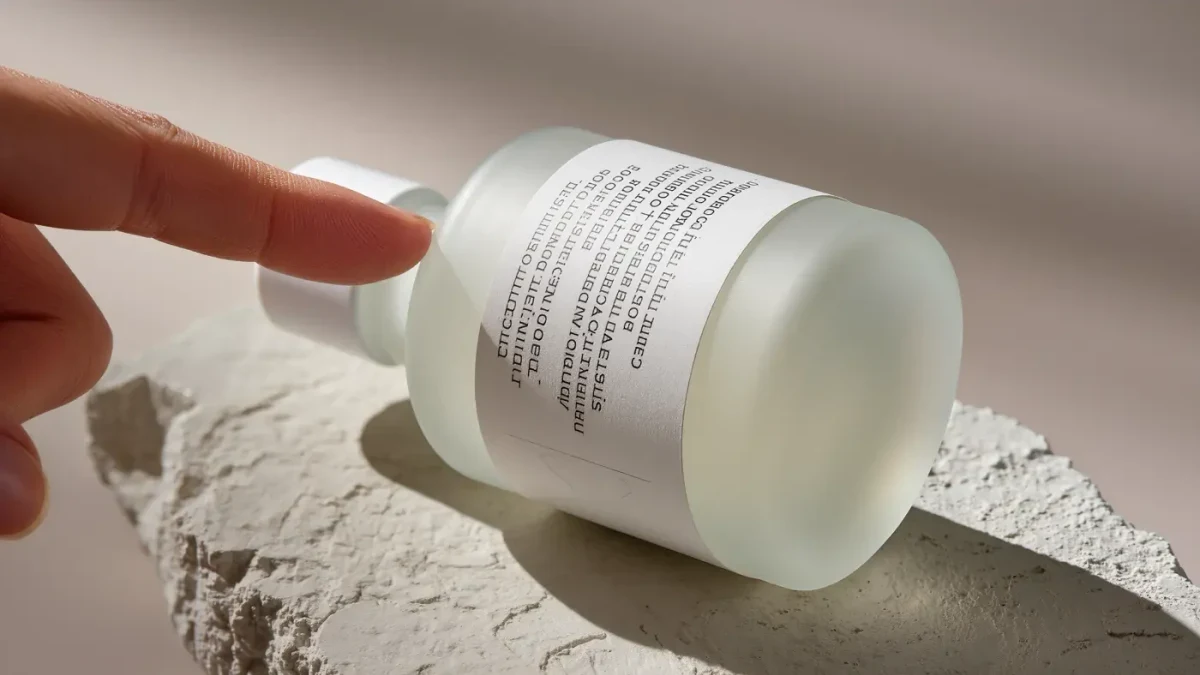
Every skincare bottle carries two labels. The front sells a story: a hero ingredient, a promise, a shade of beige that photographs well. The back carries the ingredient list, and that list is the only part regulated for accuracy. Learning how to read skincare ingredients takes about a minute per product, and it is the fastest way to stop paying for packaging.
The list follows a fixed format called INCI, short for International Nomenclature of Cosmetic Ingredients. Ingredients appear in descending order of amount, down to a threshold where anything present at one percent or less may be listed in any order after it. That single rule does most of the work. If the ingredient the jar is named after sits below the preservative, you now know roughly how much of it you are buying.
Where does the hero ingredient actually sit?
Start at the top. The first five or so entries make up the bulk of the formula, usually water, then a primary emollient or a humectant such as glycerin. If a serum advertises a plant extract on the front and that extract appears near the bottom of the list, the front is doing the selling and the back is doing the telling. This is not automatically a scam. Some actives work at low amounts. But it means the marketing weight and the formula weight do not match, and you should price the product accordingly. Readers following this should also see 2000s outfits return on the back of three objects.
A useful trick: find the preservative. Preservatives such as phenoxyethanol are legally capped at low levels, so they act as a rough marker for the one-percent line. Anything listed after the preservative is likely there at a small amount. Anything before it is a real structural part of the formula.
What does 'fragrance' or 'parfum' hide?
The word fragrance or parfum is a legally protected shorthand. It can stand for a single scent compound or a blend of many, and the manufacturer does not have to break it down. For most skin, this is harmless. For reactive skin, or for anyone managing a condition like eczema, it is the one entry worth treating as unknown. Fragrance-free is a verifiable claim; unscented is not, because a product can be unscented and still contain a masking fragrance.
The same skepticism applies to the marketing words that never appear on an INCI list at all. Words like clean, detox and radiance have no regulated meaning in cosmetics, which is exactly why they live on the front of the box. The back of the box is where the facts live.
Which concentration red flags do shoppers miss?
Three patterns are worth memorizing.
- The buried active. A named active listed after the preservative, in a product whose entire price rests on that active. Ask what else at that position justifies the price.
- The alcohol-topped formula. Denatured alcohol near the top of a cream can feel light and sink in fast, which reads as elegant texture. For dry or sensitized skin it is a drying agent, and the elegant feel is doing the marketing.
- The extract parade. A long tail of botanical names after the one-percent line adds label appeal and shelf appeal, not much else. A short list with a well-positioned active usually beats a long list with a famous name at the bottom.
None of these red flags means a product is bad. They mean the story and the formula have separated, and you should decide based on the formula.
The 60-second checklist before any purchase
Run this in the aisle or on the product page.
- Find the hero ingredient. Note its position relative to the top of the list.
- Find the preservative. Everything after it is a small amount.
- Check for fragrance or parfum if your skin is reactive.
- Count the extracts after the preservative. More than a handful is label dressing.
- Ask one question: does the price match the position of the ingredient I am paying for?
That is the whole method. It works on serums, creams, cleansers and masks, and it works the same way at the drugstore and the department store counter. A cleanser is a special case, by the way: its actives rinse off, so judge it on texture and how your skin feels after, not on the ingredient story.
What this means for your routine
Reading labels changes what you buy, not how many steps you own. Once you can see where an ingredient sits, you can compare two products on the same shelf and know which one is spending your money on the formula. It also explains why a basic glycerin-and-ceramide cream can outperform a jar covered in extract names: position beats presentation.
It helps to know what the individual players do before you rank them. Our breakdown of Niacinamide vs Vitamin C: Which Serum Deserves the Morning Slot walks through two of the most common actives and where each earns its slot. And if you are building a routine from scratch, the rest of our beauty coverage applies the same claim-checking approach across skincare and makeup. We covered a connected angle in Niacinamide vs Vitamin C: Which Serum Deserves the Morning Slot.
Even the plain word read carries more weight than most front-of-box copy. According to The Free Dictionary, to read is to examine and grasp the meaning of written characters — which is precisely the skill the front label is designed to make unnecessary.
The practical shopping note: the ingredient list is free, printed on every product, and legally bound to the actual formula. The front label is advertising. Spend your sixty seconds on the back.